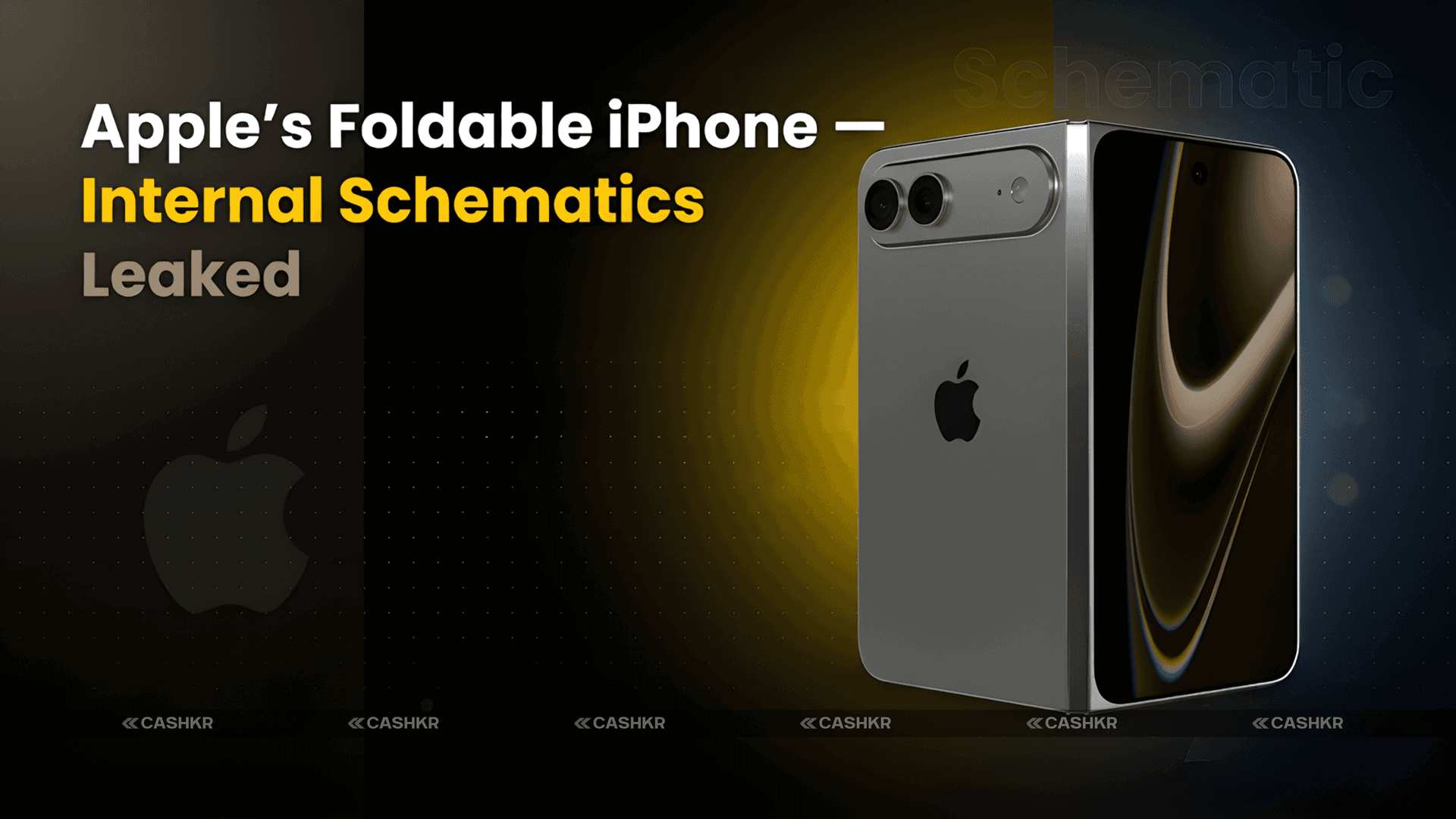
Apple's Foldable iPhone Design and Dimensions Leaked: What the Internal Schematics Tell Us
Internal engineering schematics of Apple’s foldable iPhone have surfaced online, giving us the most detailed look yet at its design. The phone folds to about 9.23mm at its thinnest point, which is just a bit thicker than the iPhone 17 Pro Max at 8.75mm, but still matches up well with other slim book-style foldables.
Apple’s foldable iPhone is expected to launch in late 2026 with the iPhone 18 Pro series. The name isn’t confirmed yet, but reports mention either iPhone Ultra or iPhone Fold. The leaked schematics, shared by blogger Lanzuk (yeux1122), are internal CAD drawings, so they’re more reliable than concept images or third-party mockups.
This article covers all the dimensions and design details from the leaked schematics, explains what they mean for everyday use, and highlights the main questions that remain before the official launch.
Yaskar Jung Shahis a technology enthusiast with over 5 years of experience covering AI, machine learning, and has contributed to major tech publications worldwide. He holds a Master's Degree in Computer Science from leading institutions.
Apple's foldable iPhone quick summary from leaks: 9.23mm frame thickness folded | 4.46mm camera plateau | 13mm total at camera | 120.59mm tall closed | 167.59mm wide open | Pill camera housing with 2 lenses | Centre hole-punch cover display | Top-left hole-punch inner display | Action Button confirmed | USB-C confirmed | No Face ID cutout visible | Black and white minimum | iPhone Ultra or Fold name TBC | Expected late 2026
Apple's Foldable iPhone Thickness: How It Compares to Every Major Foldable
People often ask about the thickness of foldable phones first. Here’s how Apple’s foldable iPhone compares to its competitors:
Device
Thickness (Folded / Body)
Launch Timeline
Apple Foldable iPhone (leaked)
~9.23mm (frame, excluding camera)
Late 2026
Samsung Galaxy Z Fold 7 (expected)
~10.6mm (folded)
2026
Google Pixel 9 Pro Fold
10.5mm (folded)
2024
Samsung Galaxy Z Fold 6
12.1mm (folded)
2024
Oppo Find N5
8.9mm (folded)
2025
iPhone 17 Pro Max (slab phone)
8.75mm (not foldable)
2025
The 9.23mm thickness is measured at the thinnest part of the frame, usually at the top or bottom edge, away from the hinge and camera. With the 4.46mm camera plateau, the thickest point at the camera reaches about 13mm.
It’s worth noting that the Oppo Find N5 is the thinnest book-style foldable at 8.9mm when folded. Apple’s foldable is 0.33mm thicker at 9.23mm, but this difference is barely noticeable in everyday use.
Compared to the Galaxy Z Fold 6, which is 12.1mm thick, Apple’s foldable iPhone is much slimmer. This highlights the progress in foldable phone engineering.
First-generation foldables tend to be thicker because the hinge takes up extra space compared to regular phones. The two halves need to line up perfectly, which adds material, and the display needs protection at the fold. Apple’s 9.23mm frame thickness is impressive for a first-generation foldable.
Understanding the Dimensions: Width, Height and What They Mean in Use
The phone’s 167.59mm width when open and 120.59mm height when closed give a good sense of how it will feel to use.
When closed, the phone is 120.59mm tall, which is shorter than the iPhone 17 Pro Max at 163mm. This compact size makes it easy to carry in a pocket or bag, and you still get a large display when you open it.
When open, the phone’s 167.59mm width gives you a wide inner display. This big screen is great for watching videos, using two apps side by side, reading, browsing like on a tablet, and viewing photos in a larger format.
The main advantage of a book-style foldable is that it’s small when closed and big when open. Apple’s dimensions show they managed to keep the phone easy to carry without making it too wide when opened.
Apple's Foldable iPhone Camera: Pill Module With Two Lenses
The leaked schematics show that Apple’s foldable iPhone has a pill-shaped rear camera module. Inside, there are two cameras stacked vertically, an LED flash, and a spot for a secondary microphone.
Having two rear cameras is fewer than the three on the iPhone 17 Pro Max. But fitting cameras into a foldable phone is harder than in a regular phone. The periscope telephoto lens used for optical zoom is especially thick and tough to fit in a device that needs to fold flat.
The pill-shaped camera module looks different from the square camera bumps Apple has used since the iPhone 11. This new shape lets the lenses fit better within the limits of a foldable phone’s design.
The schematics don’t show the exact specs of the two cameras. Based on Apple’s usual choices, they’re probably a main wide-angle camera and either an ultrawide or a telephoto lens. Apple often includes an ultrawide lens before a telephoto in less expensive models.
The Two Displays: Cover Screen and Inner Screen Explained
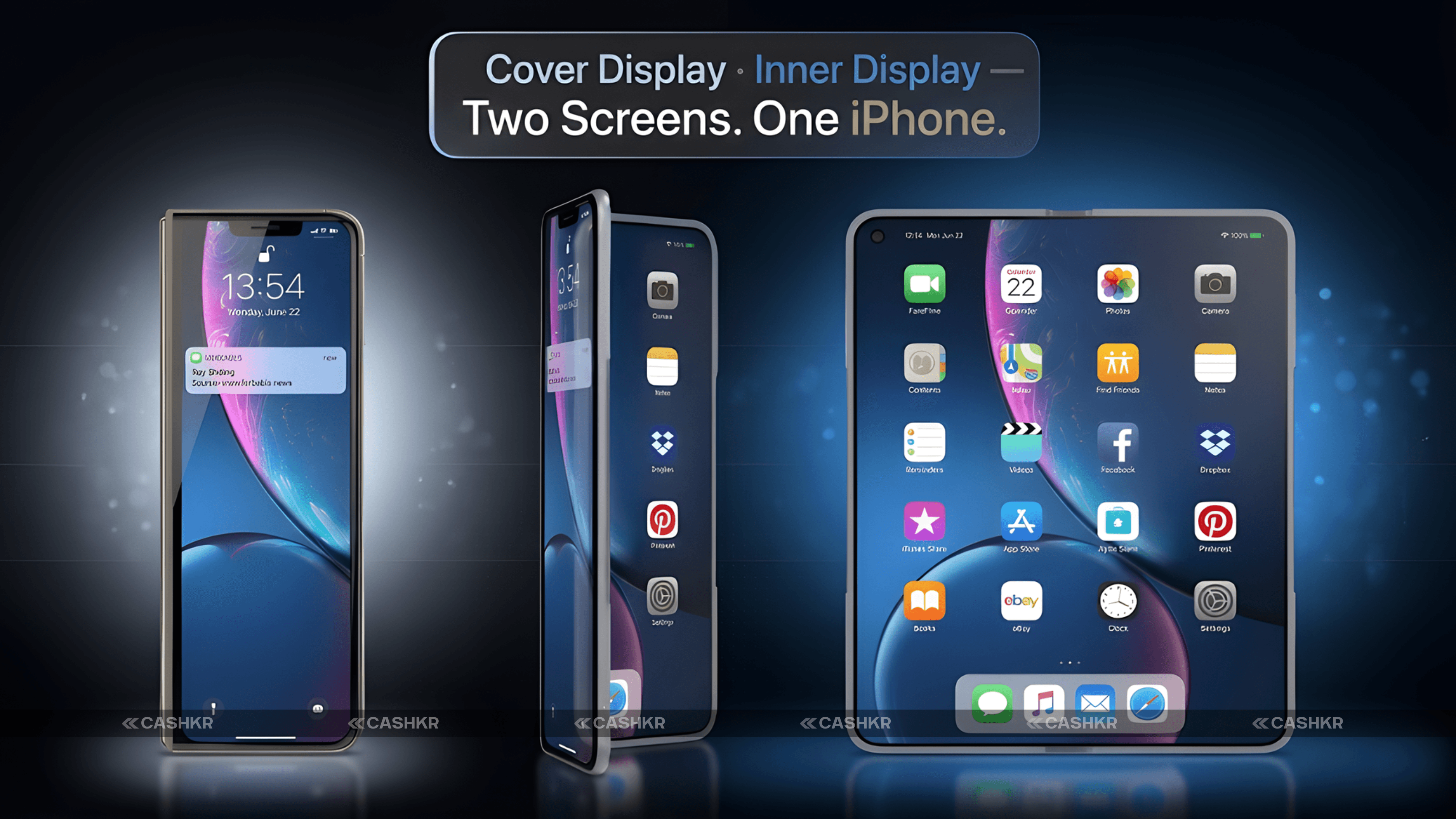
The schematics show two display panels on Apple’s foldable iPhone. Each screen has its own selfie camera hole-punch, but they’re placed in different spots.
The cover display, which you see when the phone is folded, has a selfie camera hole-punch in the center at the top. You can use this screen to check notifications, read messages, answer calls, and take selfies with the rear cameras using the cover screen as a viewfinder. The center hole-punch looks balanced and is similar to what Samsung and Pixel phones use.
The big inner display has its selfie camera hole-punch in the top-left corner instead of the center. This puts the camera out of the way, so you get more space in the middle for apps, videos, and other content. It’s a choice that favors screen usability over perfect symmetry.
One of the most talked-about details in the leaked schematics is that there’s no visible Face ID sensor cutout on either display. Current iPhones have Face ID in the Dynamic Island at the top, but the foldable only shows hole-punch cutouts, not a separate area for Face ID hardware.
This leaves three options: Apple might have created under-display Face ID for the foldable, which would be new for them. The Face ID sensors could be packed into the hole-punch area. Or, the schematics might just be incomplete and not show the final design. Apple hasn’t commented on any of these ideas.
Physical Controls: Action Button, Buttons and Ports Confirmed
The leaked schematics clearly show several physical buttons and controls.
Action Button on the left side: The Action Button, introduced on the iPhone 15 Pro and carried over to the iPhone 16 and 17 series, is confirmed on Apple's foldable iPhone. It appears on the left side alongside the volume controls. The Action Button can be customized to activate any function: camera, torch, silence, translate, accessibility shortcut, or any installed app.
Power button on the right side: The power button is on the right side, consistent with standard iPhone placement.
USB-C port at the bottom with speaker grille: USB-C appears at the bottom of the phone alongside a speaker grille. Apple switched the iPhone to USB-C with the iPhone 15 generation, and the foldable is expected to continue with USB-C.
No Camera Control button visible: The Camera Control button that Apple introduced on the iPhone 16 series does not appear in the schematics. It is unclear whether this means Apple is omitting it from the foldable or whether the schematics at this stage of development do not show all final elements.
The Action Button and volume controls are on the left side, just like on current iPhone Pro models. If you already use an iPhone Pro, the button layout on the foldable will feel familiar when the phone is closed.
What Apple's Foldable iPhone Design Tells Us About Apple's Strategy
Looking at all the leaked schematics together, Apple’s foldable iPhone design shows how the company is approaching the foldable market.
The 9.23mm frame isn’t the thinnest, but it’s still competitive. Apple could have made it thinner by shrinking the battery or simplifying the cameras, but instead, they seem to have focused on durability, display quality, and reliable components rather than just making the phone as thin as possible.
Choosing two cameras instead of three shows Apple balanced camera features with keeping the phone thin. Fitting three cameras, especially a periscope telephoto, into a 9.23mm foldable is very difficult. Apple seems to have picked a camera setup that works well within the limits of the foldable design, even if it doesn’t match the Pro Max.
The familiar button layout, with the Action Button, power button on the side, and USB-C, suggests Apple wants the foldable to feel like a regular iPhone, not a totally new type of device.
Two selfie cameras, one on each display, ensure that, whether the phone is open or closed, high-quality selfie and video call capabilities are available. This is both practical and premium: it adds cost and complexity but removes the friction of opening the phone for a selfie or flipping it for a video call.
Complete Leaked Specifications Summary
Feature
iPhone Fold / Ultra – Leaked
Folded Thickness (Frame)
~9.23mm at thinnest point (excluding camera plateau)
Camera Plateau Height
~4.46mm above the frame
Total Thickness (Camera Area)
~13mm (frame + camera combined)
Folded Height
~120.59mm
Unfolded Width
~167.59mm (landscape orientation)
Rear Camera Housing
Pill-shaped module with 2 lenses, LED flash, mic cutout
Cover Display Selfie
Hole-punch cutout (centre-aligned at top)
Inner Display Selfie
Hole-punch cutout (top-left corner)
Face ID Cutout
Not visible in leaked schematics
Camera Control Button
Not visible in leaked schematics
Action Button
Confirmed on left side (with volume buttons)
Power Button
Confirmed on right side
Port
USB-C at the bottom
Speaker
Bottom speaker grille alongside USB-C
Confirmed Colours
Black and white (minimum)
Expected Name
iPhone Ultra or iPhone Fold (not confirmed)
Expected Launch
Late 2026 (alongside iPhone 18 Pro series)
Final Verdict
The leaked schematics suggest Apple’s foldable iPhone is carefully designed, not just focused on specs. With a 9.23mm frame, wide book-style design, two selfie cameras, the Action Button, USB-C, and a unique pill-shaped camera, Apple seems to have used the same careful approach as with its regular iPhones.
Apple’s foldable iPhone won’t be for everyone. It will likely cost much more than the iPhone 18 Pro Max and most Android foldables. But for buyers who want the Apple ecosystem, a wide inner display, and Apple’s trusted software and services in a foldable, the design shows this phone has been in the works for years and wasn’t rushed by competition.
Bottom Line: Apple's foldable iPhone leaked schematics show 9.23mm frame thickness when folded, 13mm at the camera, 120.59mm tall when closed, 167.59mm wide when open, a pill-shaped dual rear camera, a center hole-punch on the cover display, a top-left hole-punch on the inner display, an Action Button, volume controls, a power button, and USB-C. No Face ID cutout visible. No Camera Control button visible. Named iPhone Ultra or iPhone Fold. Expected late 2026 with iPhone 18 Pro. Price and full specs not confirmed.
FAQs
1. What do we know about Apple's foldable iPhone from the latest leak?
Internal engineering schematics leaked by blogger Lanzuk (yeux1122) reveal the phone's physical dimensions and design layout. The frame is 9.23mm thick when folded, the camera plateau adds 4.46mm, the phone is 120.59mm tall when closed and 167.59mm wide when open. Both the cover and inner displays have hole-punch selfie cameras. The Action Button and USB-C port are confirmed. No Face ID cutout or Camera Control button is visible.
2. Why is Apple's foldable iPhone slightly thicker than the iPhone 17 Pro Max?
A foldable phone must fit two display panels and a mechanical hinge in the same space that a standard phone uses for one screen and a solid chassis. The hinge mechanism takes physical space. The 9.23mm frame thickness of Apple's foldable is actually competitive for a book-style foldable when compared to existing models, and is thinner than the Samsung Galaxy Z Fold 6 at 12.1mm.
3. What form factor is Apple's foldable iPhone?
A book-style or book-fold foldable. The phone opens left to right like a book to reveal a wide landscape inner display. This is the same format as the Samsung Galaxy Z Fold series. When closed, the compact 120.59mm height fits in a pocket. When open, the 167.59mm width provides a large, wide-format display.
4. How many cameras does Apple's foldable iPhone have?
The leaked schematics show two rear cameras in a pill-shaped housing along with an LED flash. Two cameras is fewer than the three on the iPhone 17 Pro Max. A dual camera system is consistent with the engineering constraints of a foldable form factor, where fitting a thick periscope telephoto lens alongside a functional hinge is significantly more challenging than in a standard slab phone.
5. Where is the Face ID on Apple's foldable iPhone?
The leaked schematics do not show a visible cutout for Face ID sensors on either the cover display or the inner display. Whether Apple has developed under-display Face ID, repositioned the sensors or made other design changes is unknown. This is one of the most discussed open questions from the leak.
6. Does Apple's foldable iPhone have the Action Button?
Yes. The Action Button is visible in the leaked schematics on the left side of the phone alongside the volume controls. The Action Button, introduced on the iPhone 15 Pro and carried over to the iPhone 16 and 17 series, lets users customize a physical button to activate any function or shortcut.
7. Does Apple's foldable iPhone have a Camera Control button?
No Camera Control button is visible in the leaked schematics. The Camera Control button debuted on iPhone 16 and appeared on iPhone 17. Its absence from the foldable schematics may mean Apple is omitting it from this model or the schematics are from a development stage before that element was finalized.
8. What will Apple's foldable iPhone be called?
Reports suggest either iPhone Ultra or iPhone Fold. Apple has not confirmed the name. The final product name will be announced at Apple's official launch event.
9. When is Apple's foldable iPhone expected to launch?
Reports expect a late 2026 launch alongside the iPhone 18 Pro and iPhone 18 Pro Max. Apple typically announces new iPhone models in September each year. An official Apple announcement has not been made.
10. What will Apple's foldable iPhone cost?
Apple has not announced pricing. Analyst estimates suggest a starting price significantly above the iPhone 18 Pro Max, potentially in the USD 2,000 to USD 2,500 range internationally. India pricing will be confirmed at or after Apple India's official launch announcement.
If you want to sell your old devices then, click here.